
Bitcoin Miner -Frozen Treasure
Alpha11 LimitedCasual
4.7192.00 Reviews
- Version
- 1.1.0
- Installs
- 10.00K
- Age Rating
- Mature 17+
Screenshots
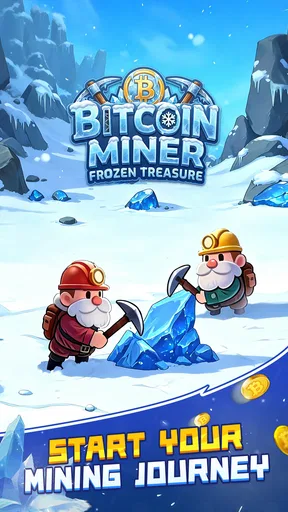
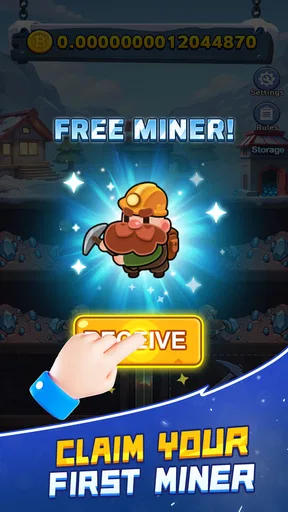
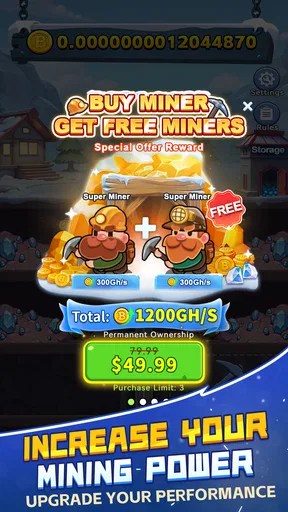
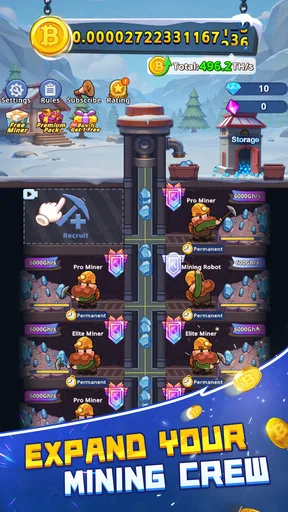
Our Review of Bitcoin Miner -Frozen Treasure
 Analysis by Appyee
Bitcoin Miner -Frozen Treasure is a casual game built around a simple promise: send miners into icy ground, uncover valuable-looking finds, and decide whether the result is worth starting another dig. I found the appeal less in complicated strategy and more in the steady rhythm of taking an action, watching the outcome appear, collecting the reward, and returning to the next attempt. It is the sort of game that can fill a short break without demanding the concentration of a traditional strategy title.
That simplicity is also the key to understanding it. This is not a serious Bitcoin tool, an investment app, or a way to earn real cryptocurrency. It is a fictional mining-themed game from Alpha11 Limited, presented as a free casual experience for mature players. The theme gives the familiar idle-mining idea a colder, treasure-hunting identity, while the short description, “Bitcoin Miner,” makes the central concept immediately clear.
I would recommend approaching it as a light progression game rather than as a simulation. The satisfaction comes from seeing a small expedition produce something, then using that sense of progress as a reason to continue. If you enjoy games where the next action is always easy to understand, this has a promising starting point. If you need deep exploration, a strong story, or meaningful long-term planning, its narrow loop may feel thin.
Starting a dig and understanding the first action
The first useful question is not whether the game sounds exciting, but whether its basic action feels comfortable enough to repeat. In this case, the fantasy is straightforward: miners go down into frozen terrain and search for treasures associated with the Bitcoin theme. The concept needs very little explanation, which makes the opening approachable even if you have never played a mining game before.
That low barrier is one of its strongest qualities. I do not have to learn a large map, memorize a complicated control scheme, or understand a long list of systems before doing something useful. The game places its emphasis on the expedition itself. You initiate the activity, wait for the result, and then decide what to do with the outcome. For a phone game, that clarity matters because many sessions begin when I have only a few spare moments.
The action is best understood as a compact commitment. I am not simply tapping for a visual effect; I am beginning a small cycle that should produce feedback later. That distinction gives the game more purpose than a completely passive screen, even though the overall experience remains casual. The frozen setting also helps the action feel more specific than an ordinary coin-collecting interface. Digging through ice suggests uncertainty, discovery, and the possibility that the next attempt may be more rewarding than the previous one.
One practical tip is to treat the first few sessions as a way to learn the game’s pace rather than as a race toward the biggest possible result. Pay attention to how quickly an action resolves, what the reward screen emphasizes, and which prompts interrupt the flow. This helps you decide whether the game suits your habits before you become invested in its progression. It is a better approach than assuming that every mining-themed game uses the same rhythm.
The mature age classification is worth taking seriously. A rating of Mature 17+ means I would not choose this casually for a child’s device, even though the game belongs to the casual category. Adults looking for a harmless-looking time filler should still check the presentation and purchase prompts for themselves before handing over a phone. The theme may sound playful, but the age label should guide who uses it.
It is also important to keep the Bitcoin language in the right frame. The game uses that idea as part of its fictional reward structure. I would not install it expecting wallet functions, market information, or real-world mining. Anyone interested in actual cryptocurrency management needs a completely different kind of product, with financial and security considerations that do not belong to this game.
Why the first tap can be enough
Casual games often succeed when their first meaningful interaction is obvious. This one benefits from not burying its central idea under unnecessary setup. The mining fantasy is immediately readable: miners are sent out, frozen treasure is the goal, and the player waits for a result. That makes it suitable for a quick evening session or a short pause during a commute, provided the player is comfortable with the game’s mature classification.
There is a trade-off, though. Easy entry can also mean limited initial depth. Players who want to make a dozen decisions before the first result will probably find the opening too light. I see this as a game that earns attention through repetition and anticipation, not through a demanding tutorial or a complex first challenge.
The feedback rhythm: action, result, and the urge to continue
The heart of the experience is the feedback rhythm. A good casual loop answers three questions quickly: what did my action do, what did I receive, and why should I act again? Bitcoin Miner -Frozen Treasure is organized around that sequence. The mining action creates anticipation, the discovery supplies a result, and the reward gives the next session a reason to exist.
That rhythm is more important than the individual theme elements. Frozen ground and miners provide the setting, but the repeatable exchange between effort and feedback is what keeps the game moving. I found it useful to judge each session by how clearly that exchange comes across. When the result feels easy to read, the game becomes relaxing. When the reward feels disconnected from the action, the whole experience risks becoming a string of taps without much meaning.
The strongest use case is a player who likes gentle progress while doing something else. I can imagine opening it while waiting for food, taking a short break from work, or settling down before bed when I want interaction without a demanding challenge. The game’s value in those moments is not that it transforms a few minutes into a major accomplishment. It gives those minutes a small structure: start an expedition, check the outcome, collect the benefit, and choose whether to continue.
A less obvious way to enjoy it is to set a personal stopping point before beginning. For example, I might play until one mining cycle feels satisfying rather than continuing automatically. This protects the game from becoming background tapping and makes the reward feel like a conclusion instead of a trigger for endless repetition. It is especially useful in free games where the loop may be designed to encourage another session immediately after a result.
The feedback also determines whether the game works for different personalities. Players who enjoy visible accumulation and small discoveries may find the rhythm comforting. Players who need constant novelty may notice repetition quickly. Neither reaction is wrong; it depends on whether the reward is valuable to you as a moment of progress or only as a step toward a larger, more complex goal.
Compared with a typical puzzle game, this experience asks less from the player’s problem-solving ability. There is no need to search for a hidden combination or plan a board several moves ahead. Compared with a conventional idle game, the frozen-treasure theme gives the loop a more active identity, even if the underlying pleasure still comes from repeated collection. The difference is mainly in presentation and mood, not in turning the game into a deep management simulator.
Where the rhythm may lose momentum
The same repeatability that makes the game easy to pick up can become its main weakness. If every expedition feels too similar, the player may begin to see the reward screen as a routine interruption rather than a discovery. I would pay attention to whether each result changes what I want to do next. If it does, the loop has momentum. If it merely confirms that I should tap again, the experience may work better in very short bursts.
Another point of friction is the presence of in-app purchases. The game is free to download, but individual purchases range from $9.99 to $699.99. That is a very wide range, and it makes restraint important. I would never treat the largest purchase option as a normal part of casual play. Before spending anything, I would ask whether the purchase improves a specific part of my experience or simply shortens the waiting and progression that give the game its purpose.
My practical advice is to play without spending first. Learn whether you enjoy the action-feedback cycle on its own, and do not let a reward screen make the decision for you while you are still excited by a discovery. If the free loop is not satisfying, paying will not fix the underlying mismatch. If it is satisfying, you may find that no purchase is necessary for the way you want to play.
Rewards, progression, and what they are really worth
Rewards are the emotional center of a mining game. They turn an ordinary action into a small event and give the player a reason to return. Here, the idea of frozen treasure makes each result feel like a find rather than a plain score increase. That framing helps the game stand apart from a generic number-goes-up interface, at least when the presentation makes the discovery feel connected to the expedition.
I would judge the reward system by three standards. First, can I understand what I received without studying the screen? Second, does the reward affect my next choice or simply add to a total? Third, does the game make a modest result feel worthwhile, or does it constantly suggest that only a larger outcome matters? These questions are more useful than focusing on the Bitcoin label itself.
A good way to play is to separate immediate pleasure from long-term value. The immediate pleasure is the reveal: something has been uncovered. The longer-term value is whether that result changes the next expedition, improves my sense of progress, or gives me a reason to return later. If the game delivers only the first part, it can still be pleasant, but it becomes more of a brief reward machine than a substantial casual game.
This is where it differs from puzzle alternatives. In a puzzle, the reward often comes from solving a problem that I personally understood and overcame. In a mining loop, the reward comes from initiating an activity and receiving an outcome. That can be more relaxing, but it also gives me less control over the exact shape of success. Players who prefer skill-based certainty may be happier with matching, word, or logic games, where improvement is clearly tied to their decisions.
It also differs from management games that let me balance workers, resources, and production chains. The mining fantasy may suggest a larger operation, but I would not assume that the game provides the same depth as a full tycoon title. Its appeal is the compact expedition and its reward, not necessarily the detailed running of an industrial network. That makes it easier to play, but potentially less satisfying for anyone seeking a complex system to optimize.
One useful habit is to notice what makes you start another session. Is it curiosity about the next find, a desire to build a larger total, or simply the convenience of having an immediate action available? Your answer can tell you whether the game is meeting your expectations. If curiosity is the main driver, short sessions may remain enjoyable. If you are waiting for a deep strategic payoff, the game may not provide enough control.
Spending and the value of a free game
The free price makes trying the game easy, but free access does not automatically mean a frictionless experience. The listed purchase range reaches from $9.99 to $699.99 per item, so I would approach every offer with caution. A casual game can be enjoyable without turning every reward into a shopping decision, and I would prefer to see the core loop stand on its own.
For a friend asking whether to pay, my answer would be simple: wait. Play enough to know whether the frozen-mining routine fits your attention span, then decide whether any optional purchase solves a real annoyance. Do not buy because a result feels unusually exciting or because the next session is framed as urgent. The game is most convincing when I enjoy the loop before spending money on it.
This advice is particularly relevant for players who are sensitive to pressure or who share a device with family members. The mature rating already suggests that this is not a title to leave unsupervised on a child’s phone. The purchase range adds another reason to keep control of the device and payment settings firmly in the player’s hands.
The session reset and why another dig begins
Every casual loop needs a reset. Once a reward has been collected, the previous action is finished, and the game must make the next expedition feel like a fresh opportunity rather than a duplicate. In this title, the reset is part of the fantasy: the miners return to the frozen unknown, and the possibility of another treasure restores the sense of anticipation.
I like resets that feel clean. They let me finish a small task and choose whether to continue, rather than forcing me to commit to a long run. That makes the game suitable for fragmented time. I can stop after a result without feeling that I have abandoned a complicated mission. When I come back, the idea of beginning another dig is understandable immediately.
The downside is that a reset can expose how much of the game depends on expectation. If the next expedition does not feel meaningfully different from the last, the reset becomes a button leading to the same experience. This is the point at which players should be honest with themselves. If the ritual of beginning again is enjoyable, repetition is part of the charm. If the ritual feels like a chore, the game has probably reached its natural limit for you.
A realistic everyday scenario shows the balance well. Imagine finishing a short break and opening the game for one expedition. You begin the dig, check the result, and have just enough time to decide whether to start another. If the reward gives you a pleasant sense of completion, you can close the app satisfied. If it immediately pulls you into a chain of increasingly expensive or repetitive decisions, the same short break may feel less relaxing. I would use the reset as a natural stopping point rather than assuming every result requires another attempt.
For players who enjoy longer sessions, the reset can serve as a checkpoint. After each result, pause and ask whether the next action is still fun. This small pause is one of the most useful ways to keep a casual game from taking over your attention. It also makes the game’s real strength clearer: it is good at offering a compact repeatable activity, not necessarily at providing a complete evening of varied entertainment.
Device fit and expectations
The game supports devices running Android 7.1 or later, which gives it a broad technical entry point for Android users. The current version is 1.1.0, so I would still keep ordinary expectations about updates and compatibility rather than assuming that every older phone will feel equally smooth. The practical test is simple: install it on the device you actually intend to use and see whether the interface remains comfortable during repeated reward checks.
Its audience is clearer than its technical requirements. Adults who enjoy casual collection, light mining themes, and short repeatable sessions are the natural fit. Someone searching for real cryptocurrency tools, a serious business simulator, a story-led adventure, or a competitive skill game should skip it. Choosing a different category would be better than trying to force this compact loop to satisfy an entirely different need.
The game has attracted an average rating of 4.7 from around 8.3 thousand ratings, with over 10 thousand installs. Those figures suggest that the basic concept has found an audience, but they should not replace personal testing. A high average can tell me that many players enjoy the premise; it cannot tell me whether I will tolerate the repetition, the purchase range, or the mature presentation.
My verdict on the complete loop
Bitcoin Miner -Frozen Treasure works when I treat it as a small ritual: send miners out, wait for feedback, collect the result, and decide whether another frozen expedition sounds appealing. The action is easy to grasp, the reward gives the session a clear endpoint, and the reset makes returning simple. That combination is enough to make it a reasonable casual download for adults who enjoy low-pressure progression.
Its limitations are equally clear. The game is unlikely to satisfy players who want intricate decisions, puzzle-solving, narrative development, or a realistic cryptocurrency experience. The purchase range requires discipline, especially because the game is free to start and the largest listed item is dramatically more expensive than an ordinary casual-game impulse buy. I would keep spending off the table until the free loop has already proved that it deserves more of my time.
My strongest recommendation is to use short sessions and judge the game by the quality of its reset. If you finish a dig feeling that the reward was pleasant and the next one is optional, the design is doing its job. If you feel pushed to continue without gaining anything new, move on to a puzzle game or a deeper management alternative. The real test is whether another session feels like a choice rather than a demand.
For me, this is a focused, adult-oriented casual game with a clear mining identity and an accessible action-feedback-reward cycle. It is worth trying for the frozen-treasure atmosphere and the convenience of its compact sessions, but it should be approached with realistic expectations. I would recommend it to a friend who wants a simple progression loop during spare moments, while making it clear that the game is not a financial tool and that its optional purchases deserve careful attention.
Alpha11 Limited has kept the central idea easy to understand: begin a dig, see what appears, and choose whether to reset the cycle. That clarity is the reason to play. It is also the boundary of the experience. If that loop sounds satisfying on its own, the free download offers a straightforward way to test it. If you need more variety or control, you will be happier elsewhere.
Verdict
Strengths of Bitcoin Miner -Frozen Treasure
- Simple gameplay is easy to understand for beginners.
- Mining rewards can be collected during short play sessions.
- Progression gives players goals to work toward over time.
- The frozen treasure theme adds visual personality to the experience.
- Suitable for casual players who prefer low-pressure gameplay.
Limitations of Bitcoin Miner -Frozen Treasure
- Bitcoin-themed rewards may not represent real cryptocurrency earnings.
- Progress can feel repetitive after extended play.
- Frequent ads may interrupt gameplay or reward collection.
- Some features may require in-app purchases to progress faster.
- Performance can vary on older Android devices.
Other Releases by Alpha11 Limited
View All
Bitcoin Miner - Gold Diggers
Casual4.7
Similar Picks in This Category
View All
My Talking Angela
Outfit7 Limited4.2

My Talking Tom
Outfit7 Limited4.3

Pou
Zakeh4.2

My Talking Tom 2: Pet Game
Outfit7 Limited4.3

Candy Crush Saga
King4.6

Bridge Race
Supersonic Studios LTD4.1
Frequently Asked Questions
What is Bitcoin Miner - Frozen Treasure?
Bitcoin Miner - Frozen Treasure is a casual cryptocurrency-themed simulation game in which you build and upgrade virtual mining operations. You collect in-game resources, unlock new locations or equipment, and improve production over time. Although it uses Bitcoin-inspired terminology and visuals, it is primarily an entertainment app rather than a real cryptocurrency mining tool or investment platform.
Can Bitcoin Miner - Frozen Treasure mine real Bitcoin on my phone?
No. The game does not use your device to perform genuine Bitcoin mining, and it does not generate real cryptocurrency through your phone’s processor or graphics hardware. Any coins, rewards, or balances shown inside the app belong to the game’s virtual economy. They should not be confused with spendable Bitcoin, blockchain assets, or guaranteed financial returns.
Is Bitcoin Miner - Frozen Treasure free to download and play?
The app can generally be downloaded without an upfront purchase, but free gameplay may include advertisements, optional in-app purchases, or both. These purchases can speed up progress, provide virtual currency, remove certain limitations, or unlock bonuses. Before confirming a transaction, check the store listing and your device’s payment settings so you understand the available pricing and recurring purchase policies.
Does the game require an internet connection?
An internet connection may be needed for downloading updates, loading advertisements, synchronizing progress, receiving event content, or accessing some online features. Some basic gameplay may work temporarily offline, but functionality can vary depending on the version and device. If you play without a connection, rewards or progress may not synchronize immediately, so reopening the game online can be necessary.
Is Bitcoin Miner - Frozen Treasure safe for children and younger players?
The game is generally presented as casual entertainment, but parents should still review its advertising, simulated financial theme, and optional purchases before allowing younger players to use it. Because the app may include cryptocurrency-style terminology and monetization features, children could misunderstand the virtual rewards as real money. Parental controls and purchase restrictions are recommended on both Android and iOS devices.
Play our best games!


